
The braces-versus-Invisalign question usually isn’t really about which one is “better.” It’s about which one is right for your specific teeth, your lifestyle, and your budget, three things that don’t always point in the same direction. This guide breaks down the real differences so you can walk into a consultation already understanding the trade-offs, rather than deciding purely on appearance.
- Traditional braces are generally more effective for complex bite and alignment issues, while Invisalign suits mild to moderate cases where discretion matters more.
- Invisalign is removable and far less visible, but requires more patient discipline, since aligners only work if worn 20-22 hours a day.
- Treatment time is often similar between the two for comparable cases, though complex corrections may take longer with Invisalign.
- According to Discovery Health’s published dental benefit guide, orthodontic treatment and dental appliances are paid at 100% of the Discovery Health Rate, subject to an annual limit, on qualifying plans.
- The right choice depends less on preference alone and more on what your specific bite correction actually requires, best confirmed with an orthodontic assessment.
How Traditional Braces Work
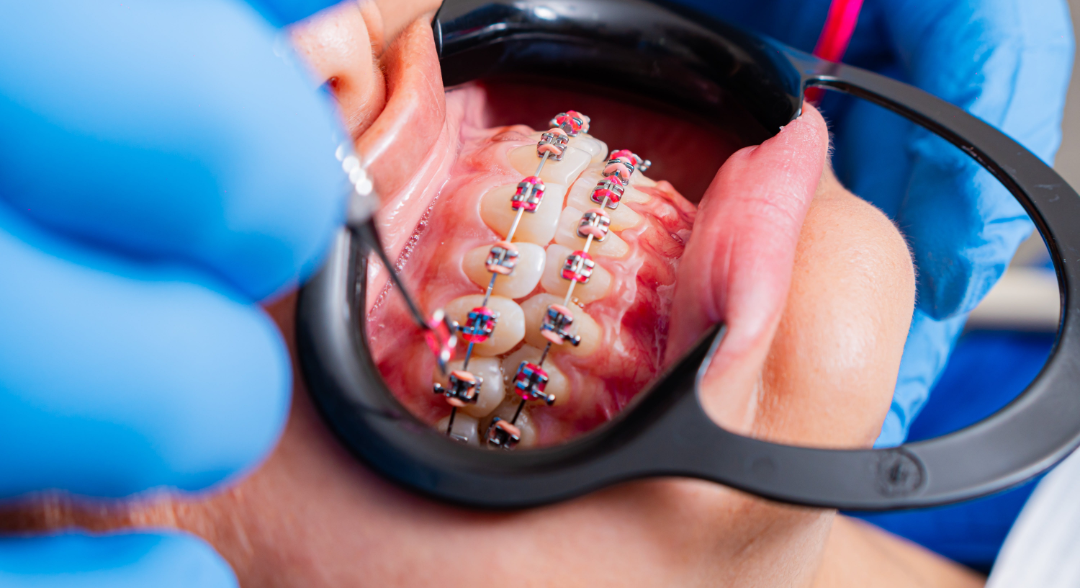
Braces use metal or ceramic brackets bonded to each tooth, connected by a wire that’s gradually tightened over time to shift teeth into position. They’re fixed in place for the full duration of treatment, adjusted periodically by your dentist or orthodontist.
Strengths:
- Highly effective for complex cases: significant crowding, bite misalignment, or rotated teeth
- No compliance required from the patient day to day, since they can’t be removed or forgotten
- Often more cost-effective for complex corrections
Trade-offs:
- Visibly noticeable, though ceramic (tooth-coloured) options reduce this
- Some dietary restrictions apply (sticky or hard foods can damage brackets)
- Requires more diligence with cleaning around brackets and wires
How Invisalign (Clear Aligners) Works
Invisalign uses a series of custom-made, clear plastic aligners, each worn for one to two weeks before moving to the next in the sequence, gradually shifting your teeth. Unlike braces, aligners are removable.
Strengths:
- Far less visible, a genuine advantage for adults in client-facing or public-facing roles
- Removable for eating, which means no food restrictions
- Easier to maintain oral hygiene, since you can brush and floss normally
Trade-offs:
- Requires strict discipline: aligners need to be worn 20 to 22 hours a day to stay on track
- Generally less effective for more complex bite or rotation corrections
- Easy to misplace or forget, which can quietly extend treatment time
Cost Comparison
Both options vary considerably based on case complexity, but as a general guide:
- Traditional braces in South Africa typically range from around R25,000 to R55,000 for a full course of treatment
- Invisalign typically ranges from around R35,000 to R70,000, reflecting the custom aligner manufacturing process and, often, more frequent monitoring appointments
Complex cases requiring longer treatment, or additional appliances alongside either option, will push costs toward the higher end of these ranges. An accurate quote requires a full orthodontic assessment, including X-rays and, in many cases, a 3D scan of your bite.
Procare Dental Surgery will assess your teeth and talk you through which option realistically fits your case and lifestyle.
WhatsApp Us
Does Medical Aid Cover Orthodontic Treatment?
Often partially, yes, though the details depend heavily on your scheme and plan. According to Discovery Health’s published cover guide for dental treatment, dental appliances, their placement, and orthodontic treatment (including related orthognathic surgery accounts) are paid at 100% of the Discovery Health Rate on qualifying plans, subject to an annual limit that’s shared with other dental appliance claims and varies by plan tier.
A few things worth confirming directly with your scheme before starting treatment:
- What your specific annual limit is for dental appliances and orthodontics, since this is often a combined limit, not a separate one just for braces or Invisalign
- Whether treatment needs pre-authorisation before it begins
- Whether there’s a difference in how your scheme treats braces versus clear aligners specifically, since not all schemes classify them identically
Momentum and Bonitas members should check their equivalent orthodontic benefit structure directly, since limits and classification rules differ between schemes.
Which Option Actually Suits You?
This is genuinely case-dependent, but a few general patterns hold:
Braces tend to be the better fit if:
- Your case involves significant crowding, rotation, or bite misalignment
- You’d rather not rely on remembering to wear something consistently
- Cost efficiency for a complex case matters more than discretion
Invisalign tends to be the better fit if:
- Your case is mild to moderate in complexity
- Visibility is a genuine concern for your work or lifestyle
- You’re confident you’ll stick to the discipline of near-constant wear
Neither option is universally superior. The honest answer only comes from an orthodontic assessment of your specific bite, not a general preference for one over the other.
Book a consultation with Procare Dental Surgery in Pretoria for an honest assessment and a treatment plan built around your bite and lifestyle.
Book Your Consultation
Frequently Asked Questions
Is Invisalign as effective as traditional braces? For mild to moderate alignment issues, Invisalign can achieve comparable results to braces. For more complex cases involving significant crowding, rotation, or bite correction, traditional braces are generally considered more effective and predictable.
How much does Invisalign cost compared to braces in South Africa? Traditional braces typically range from around R25,000 to R55,000 for a full course of treatment, while Invisalign typically ranges from around R35,000 to R70,000. Both vary significantly based on case complexity, and an accurate quote requires a full orthodontic assessment.
Does medical aid cover braces or Invisalign? Often partially. According to Discovery Health’s dental benefit guide, orthodontic treatment and dental appliances are paid at 100% of the Discovery Health Rate on qualifying plans, subject to an annual limit shared across dental appliance claims. It’s best to confirm your specific plan’s limit and pre-authorisation requirements directly with your scheme.
How long does treatment take with each option? Treatment time varies by case, but both braces and Invisalign typically range from around 12 to 24 months for full correction, with mild cases sometimes completing faster. Complex corrections may take longer with Invisalign than with traditional braces.
Sources
- Discovery Health: Cover for Dental Treatment guide (PDF)
- Discovery Health: More about your Medical Aid Dental Benefit
- South African Dental Association: Clinical Information & Articles of Interest